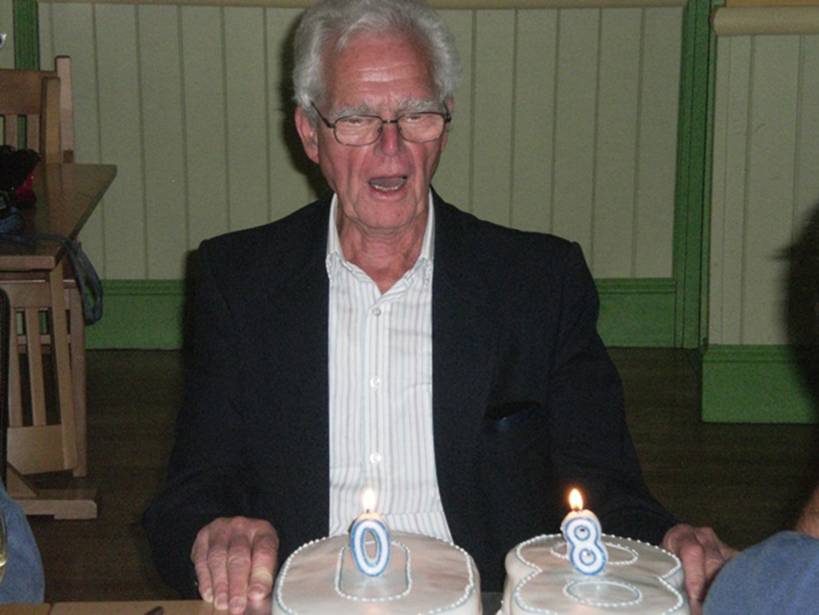
A photo of me at my 80th birthday party in
Ramsgate
Since my retirement in 1993 I have spent a
considerable amount of time trying to compile a one-name study of our
family name. Firstly by joining The Society of Australian
Genealogists and spending untold hours searching for every item in their
records re Chittendens’ worldwide. At the same time advertising in
Genealogical Magazines and the Genealogical Research Directory, which resulted
in considerable correspondence from the United Kingdom, the USA, Australia and
New Zealand Having virtually exhausted the research facilities available
in Sydney, and much prompting by Andrew and Christopher to go on the
‘Net” I eventually accepted their advice and with some doubt and trepidation I
took the ‘big step’. It has proved to be a great advantage to
accessing information from the four quarters of the globe, with the minimum of
fuss. Making contacts with researchers, worldwide, and receiving
almost instant replies. This hobby came about because several years
ago I had read that a Thomas Chittenden, from West Farleigh, Kent was, at the
age of twenty-three, given a life sentence and shipped to Australia on the ship
‘Atlas 3’ and arrived in Sydney on the 22nd July
1816. Having, during my lifetime, only met one person named
Chittenden, who was not one of my own family, I assumed that tracing Thomas
would be a simple task, needless to say I am no nearer tracing his lineage past
his parents than I am of concluding our own family tree. Using
a common genealogical expression, I hit the proverbial ‘brick wall’ in 1784 in
the search for my own ancestry.
On the 20th August 1784 the Banns
were listed for Stephen Chittenden and Mary Williamson at All Saints Parish
Church,
It does appear that Stephon my direct
descendent, born 12th June 1785, married Amelia ?????? at
Deptford,
United Kingdom Wills: This is the last
Will and Testament of me, Stephen Chittenden, Bricklayer of 20 Pearson Street,
Greenwich in the County of Kent, on this third day of December 1857 wherein I
do bequeath unto my three children at my decease, after all my debts are paid
all that remains of my personal effects and property consisting of a house
situated at 9 Roan Street, Greenwich and three cottages and shed at the back of
the said No. 9, Roan Street and also four houses No’s. 7, 8, 9, and 10 on the
east side of Pearson Street, Greenwich, and I do advise that the rents of these
houses shall be collected and after ground rent, interest on mortgage
repayments, insurance, rates, repairs and collection of any other expenses
attached thereto that occur the quarter the surplus shall be equally divided
between my married daughter Amelia Charlotte Brook and George Chittenden and
William Chittenden. And further I Stephen Chittenden do hereby
appoint William Brook or his Agent to collect all rents, pay all expenses and
obtain a new mortgage if possible should it be required but provided a new
mortgage cannot be obtained then the said William Brook shall dispose of the
property on the most advantageous terms possible with the advise of all
interested parties and for which receives a fair and proper percentage shall be
paid together with all needful expenses incurred in collecting the
same. And further that at the decease of either the before
names then all his or her part that shall be enjoyed by the husbands or wives
of the said parties and their children. And it is my desire that
all my building materials and tools then in possession shall be kept in the
shed for the purpose of repairing the before mentioned property and an equal
use of the shed be for the right of both of the interested parties.
I hereby revoke all my former Wills and make this my last Will and
Testament. As witness thereof proof I have this 3rd day
of December in the presence of ….. signed my hand George Salter,
Amelia Chittenden had married William Brook on
16th August 1841:- ‘William Brook, Bachelor, Profession:
Dyer. Father: Abraham Brook, Bricklayer. Amelia
Charlotte Chittenden, Spinster. Both of Full Age. Residence
at time of Marriage: Charlton. Marriage solemnised by Banns in the
Parish of Charlton
George Chittenden married Charlotte Mary Walter at the
Parish Church of Charlton on the 2nd December 1839.
George is listed as a Bricklayer. Charlotte Mary Walter was born in1821
and christened at St Alphage Church,
George Chittenden, my great great grandfather died in
1867, aged 48, from an accident at work. The
Death Certificate, dated 8th July 1867 states ‘Injured from an
accidental fall from scaffold. Father: Stephen Chittenden,
Bricklayer present at Death’ I remember my father telling me that
his father and grandfather were both steeplejacks.. George’s
wife, Charlotte Mary, died in 1871, aged 50, at
Stephen Chittenden, my grandfather, married Rose
Bignell in 1878 at Camberwell. Rose
was born in
Stephen Thomas 1879, William Valentine 1881, Rose
Charlotte 1883,
1890 and George Henry 1893. The 1881
Census shows Stephen (31) Factory Engineer, Rose (23) Stephen T (2) and William
V (7 months), residing at 12 Champion Terrace, Camberwell, Surrey. They
were still residing at this address in the 1891 Census, but in addition to the
four occupants shown in the 1881 Census, Thomas Bignell (57) shoemaker, Rose
(7), Flora (5) and Maude (8 months) are listed. Rose Charlotte
Chittenden married Herbert McPhurr at Camberwell in 1909. Stephen Chittenden
died 17th April 1925, aged 72, at
George Henry Chittenden, my father, married Margaret
Elsie Trower on 26th November 1921 Margaret Elsie was
born on 17th January 1899 at Cedar Lodge, Harrow Weald.
Her father Percy Trower is listed as a servant and her mother is shown as
Harriett Mary Trower, formerly Trower. The marriage certificate
reads ‘George Henry Chittenden, age 28, Bachelor, House Decorator.
who at that time lived at
Now, Arthur Sidney comes into the picture, born 30th
June 1927 at the
Which is located within the ‘sound of Bow Bells’ this
makes me a bona fide Cockney As far as I can recall my childhood
was not an unhappy one. We lived at 3
When I think back and ponder on eating, all I can say
it was very little. In the morning we usually had sliced bread and
dripping. If we were lucky we got some of the dark brown,
rich dripping, from the bottom of the basin but if we did not get in first it
was just the light coloured fat on which we poured plenty of
salt. We did get a meal, midday, at school and these were
always devoured without complaint, excluding Monday when a suet pudding was the
fare of the day and it was absolutely ghastly. Whenever I felt that
I was so hungry I had to eat it I invariably had to run outside and vomit the
lot up. I can now understand the reason for this disgusting
concoction being served on Mondays was probably the lack of time to purchase
fresh food supplies - no refrigeration in those ‘good old days’.
I can vaguely remember my Mother cooking meals at home, mainly roasts,
‘toad in the hole’, sausages and mash and stews. When mother died I
remember our father, who did his best on what he could afford, specializing in
boiled sheep’s head and pigs trotters - this put me off any form of food with
the exception of a roast or a grill for many years The
other disadvantage was that there was no dripping. After
school we were allowed bread and jam. And if we were financial a
feed of fish and chips or just the chips made into a sandwich we all thought
that they were fantastic. Maybe I often went hungry, but I never
starved. Within close proximity to where we lived was Spitafields
Wholesale Fruit & Vegetable Markets and we used to go there on Saturday
mornings to search the heaps of unsaleable fruit picking out mainly apples,
bananas, oranges and pears, which had some rotten spots, taking them home and
cutting out the bad bits.
I learnt at a very young age that working for pennies
not only gave you affluence but very often included food.
When I was about seven years old I managed to get a ‘job’ after school at a
grocery shop, on the corner of Leman and Cable Streets, on the route between
home and school. In those days there were no packaged biscuits,
they were delivered in tin boxes and the grocer sold them in paper bags, the
outcome was a lot of broken biscuits. My job was to go through all
the boxes and place the broken pieces into bags which were then sold at
discounted prices. Needless to say that whilst that job lasted my
desire for food was greatly decreased. I also discovered how
to look after ‘number one’. In my innocence I introduced a ‘friend’
to the grocer with the good intentions of getting my school friend a job and
aiding the ‘boss’ with another pair of hands. My first major
mistake in the world of employment!, within a short time, my friend took over
my job and I was out, maybe I was eating too many biscuits?. The loss of
the job did not worry me but I sure missed the feed. My next
enterprise was on Saturdays, the Jewish Sabbath, I had a job stoking the fires
and boiling the kettles in two of the apartments in our ‘Mansions’ for a
couple of Orthodox Jewish families. They were people who had left

A view of the school taken in July 2007

We attended St Pauls School,
Until our mother died we regularly attended St Pauls
Church, Dock Street and I was a choirboy at the Sunday morning services,
although I don’t think I contributed much to the singing as I seemed to have
had a habit of fainting whenever we stood up to sing and often ended up
stretched out on a bench in the vestry. As proof of my religious
upbringing I still have a Book of Common Prayer & Hymns Ancient and Modern
presented on January 19th 1938 for regularity - no commendation for
my singing ability or other attributes.. When our mother died in
March 1938 my church attendance ceased. It was not until I
started compiling our family history I realized what a sad period this must
have been for my father. His mother, Rose died in February 1937,
his father, Stephen had died in 1925 and Margaret Elsie had lost her last
child, Pauline, born earlier in 1937, and he then lost his wife a few months
after. Immediately after our mother’s death I was aware that
the Council Officers and the Church Authorities were pestering my father to
give up us kids and have us placed in a ‘home’ My father
would not hear of it and claimed that our sister Elsie was able to care
for us.
With all this turmoil and uncertainty there was no
compulsion for us to attend church on Sunday’s and my Jewish school friend was
able to get me a job with a Jewish lady who had a fish stall in Petticoat Lane,
she sold mainly Kosher fish like Rollmops, Soused Herrings, Pickled Fish,
Sardines, etc. This employment continued for some time
and although I did not care for the rollmops, sardines in a couple of slices of
bread were okay - trying to live by the old saying ‘If it won’t fatten at least
it will fill you up’. Unfortunately my career as a Kosher
fish seller came to an end due to the lady’s philandering husband.
She explained to me that her husband was having an affair and I was to follow
him and his girl friend to find out the address of the residence they visited.
I was given money for bus fares and sent on my mission. I
vaguely remember that there was no problem following them.
They caught a bus going to Mile End and after a couple of stops they got off,
so did I, and they walked a short distance and then turned left with me
on their heels - as I turned the corner they were there waiting for me - it
taught me another important lesson in life - always try to get some training
before taking on a new venture or at least do some homework. They were
very friendly and gave me some money - cannot remember how much - and sent me
on my way. Needless to say I did not go back to the fish
lady I continued to earn my Sunday pocket money in Petticoat Lane
helping on a fruit stall by unpacking the boxes of fruit and sorting out the
overripe stuff. One other job with a difference was working for a
‘quack’ medicine salesman. All I had to do was sit on a kitchen
chair and put on an act that I had a pain in the arm, or leg or whatever was
his speil for the day and he would try and convince the crowd that he had the
perfect cure using me as the guinea pig to apply his bandages and potions - the
only trouble with that job was every time I seemed to get comfortable he got
the wink that the ‘Law’ was approaching so I had to pick up the chair and
‘scarpa’, meeting him at a pre-arranged spot to set up for another
session. That job did not last long as there was nothing to
eat.
The year was now 1939 and in August my childhood
came to an abrupt end and my father’s dispute with the Council and Church
officials were all resolved thanks to Adolf Hitler. War was
imminent and the London County Council started planning the evacuation of
mothers and children from
The history of the East End of London goes back to
medieval times and has been a place of notoriety for the past five hundred
years. The records state that
Bank to the west of the Square In the
nineteenth century a stone cistern containing the remains of two children was
unearthed in the Square. Robert Mutton who died in 1669 owned
houses, yards and wharves near Execution Dock, and lived there
himself. Francis Hooper who died in 1692 had four, sixty pound
houses on the Highway and eleven smaller, thirty pound, houses in
The street where we lived, Goodman Street, which ran
parallel with Leman Street, was named after Mr Thomas Goodman, one of the local
well-to-doos’ and where he probably had his residence. In the
1860s’ there was a temporary shelter and soup kitchen for Jews.
Between 1870 and 1914. 120.000 Jews came to
I remember the great street party we had in 1936 when
I had one very good Jewish school friend whose father
was the caretaker of the Brick Lane Synagogue,
where, if his Dad was not around we would sometimes go
and play after school. It was interesting to read that this
particular building was first, a French Chapel catering for the Huguenot
Immigrants who started settling in the East End to escape the religious persecution
in
For many years I had a yearning to take a trip and
have a walk down ‘memory lane’. That was until I heard that
it is now almost impossible to recognize the area. Apparently the
whole area between the Highway and the Wapping river front has been
redeveloped. The old Western and Eastern Docks have all been filled
in and the biggest single activity now is newspaper production - News
International (Rupert Murdoch’s empire) has its United Kingdom Headquarters
there.
The great evacuation of Londoners started a few days
prior to the 3rd September 1939. My father decided that
Elsie and Steve could stay in
We were transported to the railway station in buses
and then checked onto the train. Nobody had a clue as to our
destination. ‘Had to be kept secret just in case there was a
German spy in the station’. The good thing about the trip was
the issue of a packed lunch - sandwiches, fresh fruit and dried sultanas - it
was the first time I had ever tasted dried fruit and I still enjoy
it. Being grouped in classes I had no idea how
Jim, John or Dorothy were faring, but as I had always been a loner, this did
not worry me. When the train eventually pulled out of the station
our spirits were high and the teacher encouraged us join in singing songs like
“We’re going to hang out our washing on the Siegfried Line” which referred to
the German front line - the French had built the Maginot line opposite the
German defences - it was claimed to be impenetrable - which proved correct
because it was never put to the test - when the Germans attacked in May 1940
they invaded Belgium and the Netherlands and just went round the side of the
French defences. Another song was ‘Run Adolf, Run Adolf, Run,
Run Run.. The train eventually arrived at
The regimentation at the Vicarage was something
completely foreign to my upbringing. I ate in the kitchen,
the housekeeper fed me well and tried to make me feel at home. I
caught the bus to and from school, but was instructed to come straight home and
following a glass of milk and biscuits to go up to my bedroom until dinner
time. On Saturdays’ I was allowed to mix with local
children nominated by my foster parents. This was not unreasonable
but I really missed the companionship of my school friends. On Sundays’,
the Vicar decided that I would attend his Church to pump the organ at the
morning service, attend Sunday School in the afternoon, and return again
to the Church in the evening to pump the organ. He ruled that as it
was the Sabbath I would walk to Church, as it was wrong for fit and healthy
children to ride in buses on the Lord’s Day. I always thought
that his Church, which was in the town of Eastbourne was probably some two and
a half miles from his residence, but having recently made a few enquiries
it was most likely less than a mile. This would still have been
over five miles walking every Sunday.
It was whilst we were at church that the outcome of
the British ultimatum to the German Government that its troops should
leave Poland was delivered at 9 am on Sunday 3rd September
1939. It expired at 11 am without a reply and the Prime Minister,
Neville Chamberlain made an announcement on the radio sic I have to tell
you that no such assurance has been given and that therefore we are at war with
Needless to say the Vicar did not have me as a guest
for long. I was given pocket money every Saturday, I believe that
this was part of the sum paid to the foster parents by the government, and
fortunately due to my restricted life style, after a couple of months I had
saved up enough to buy a train ticket to London. So one
Saturday morning, at breakfast, I told the housekeeper that a friend and I were
going walking on the Downs for the day So after breakfast I
went up to my room and packed all my clothes, I should really say their clothes
because they had disposed of everything I had arrived in and replaced them with
‘second hand’ garments and footwear of which I was most proud and had no
intention of leaving behind. I managed to get clear of the house
with my shopping bag and caught a bus to Eastbourne Railway Station and arrived
home in the early afternoon. You could say I went from the frying
pan into the fire. There was no family welcome, no sisterly love,
just a long tirade from my father who had to contact the Vicar and let him know
that I was back in
When we arrived in
Eastbourne is a town, in the
Having settled into my new billet, enjoying the scouts
and all my new friends it came as a shock to be told that I would be
moving. Maybe my ‘foster mother’ found that having a child in
the house was too demanding or maybe her health was not good, or it could have
just been a temporary home until a permanent billet was found, anyway I was on
the move. The one outstanding memory I have is of the fantastic
Yorkshire Pudding she used to make when we had our Sunday roast dinner, and
very often when it was not a roast she would make a sweet Yorkshire Pudding and
serve it with custard.
My new billet which was situated in the
This occurred in May 1940 when the decision was made
that we were to leave Eastbourne for a destination, unknown, and eventually
after a journey which we began to think would never end were told that the
train was in the County of Pembrokeshire, South Wales. At each
station the train stopped and a group of children disembarked.
Following many stops our group were put off in a small town called

Wiston Sign 2007

Wiston Church 2007

Wiston School 2007
For my first couple of nights I was lodged at the
Vicarage, in the

Woodland Farm Gate
Our evacuation to
Re Country Life: Milking - The main income
from the farm was milk and cream and I believe that every farmer had a cow
called Daisy. We had an average of fifteen milking
cows Milking was a twice daily chore.
The cowshed was certainly the warmest place to be in winter but rather hot and
smelly in summer. The cows were milked by sitting on a
three legged stool with a bucket between your legs held secure with your knees,
just in case the cow should kick, not an unusual happening, it was also wise to
keep your head pressed against the animal’s flank as a cranky cow could give
you a severe clout with her tail. By squeezing the teats and
pulling the milk would flow. This was fairly easy with the old cows
who had large teats, but a rather tedious task with the first timers as their
teats were small and rather thin. When the milking was
finished the milk for market was placed into ten gallon churns for collection
by the daily milk run. But it was always necessary to keep
sufficient for cream and butter making. The milk was poured into a machine
called a separator, this was a device that used centrifugal force to spin the
lighter cream from the heavier milk. It was manually operated
and by turning the handle the milk from the upper chamber divided the cream
from the skim milk which were directed into their separate
outlets.. The skim milk was used for the feeding of calves and
pigs. The cream was used in the kitchen for cooking and
also for making butter. The cream was placed into a large wooden
urn which was fitted with a handle that had to be manually turned until the
contents became almost solid, it did not require any inspection as the handle
would begin to jam and jerk and would be very difficult to turn, the raw butter
would then be separated from the buttermilk. After adding salt the butter
would be shaped into small blocks with two wooden spatula type
utensils.
Bread baking was another routine chore.
The flour was placed into a large mixing basin and with a dash of milk and
water was mixed into a dough, yeast was then added and the mixture placed into
the open oven overnight. In the morning it was divided into loaf
sized pieces and then placed into the baking oven and in a short time the
freshly baked bread was ready for consumption. Following the
bread baking it was standard practice to place whole freshly caught,
skinned and cleaned rabbits into the oven which were always a popular
luncheon dish.
It was customary for all farmers to breed a pig for
home consumption . The slaughter of the creature was almost a
ritual. Firstly it was necessary to have a keg of ‘home
brew’ ready for the occasion. The pig killing always occurred in
the late afternoon, after the milking was completed and a few neighbours came
to assist. The brass ‘brewing pan’, which was large enough to
hold twenty gallons of water and sat on an iron frame under which a fire was
lit. A gallows was erected with hook spreader and
endless chain was alongside the ‘pig block’ a solid timber bench, six feet
long, three feet wide and raised about three feet above the
ground. The animal had to be manhandled from the sty and
placed on the block, requiring plenty of manpower, usually between six and ten
men would lie on the screaming pig whilst the nominated butcher would stick a
knife into the pig’s throat and all hands plus bodies holding the pig down
until it had bled and given a last grunt. It was impossible to keep
pig killing private as the creature’s squealing could probably be heard for a
radius of five miles The next task was to cover the exposed
side with cotton sheeting and pour the scolding water over the
carcass. The sheeting was then removed and we all got scraping with
rather rustic type scraping tools. These were normally curved
hoop iron gadgets with a metal bar welded across the top under which the
fingers fitted to clasp the outside edge. They were kept
razor sharp and very efficient. When the skin was clean and
white the carcase was turned over and the other side was given the same
treatment. On completion the carcass was attached to the hook
and with the help of many hands was pulled up rear end first on the
gallows. The animal was then gutted, the offal was taken into
the house most of it being usable. The heavy work having been
completed the keg of beer was tapped whilst the women cooked up the ‘fry’ which
was usually served with freshly baked bread, etc. The carcass
was left hanging overnight to cool. The following day it was cut
down the centre, from tail to head and when dissected into manageable sections
was taken into the house for butchering. The hams and
sides of bacon were rubbed with salt and placed on a timber slat rack suspended
from the kitchen ceiling, above the dining table and operated by
pulley. The smoke from the kitchen range cured the meat on the rack. The offal
was used for sausage making, brawn, etc. It was customary for
neighbours to rotate their pig killing so that an exchange of fresh meat was
standard practice.
To be continued – when I find the time (-;)
adjacent to
St Pauls Church was in
In
‘Garricks departure marked the end of good theatre in
the
The Royalte Theatre,
To Great Apollo, God of early morn…. We consecrate this shrine of gentle
music.
The East End had long attracted threatre-goers from
the
Like other East End music halls,
There was, however, in the early eighteenth century one
enclave in the Tower Hamlets where it seemed as if the pattern of development
might run parallel to Holborn or Marylebone,
Off
Whitechapel parish had a Danish chapel in
The East End also had
(My family lived in
cross street was Alie - we walked down
school in
to
Goodman’s Fields Theatre in
The way in which the immigrant groups changed, almost
from one generation to the next, is exemplified by a single building on the
corner of
The Fanny Waxman’s Yiddish Theatre operated in
Clement Attlee was Secretary of Toynbee Hall before
becoming mayor of Stepney, and MP, succeeding George Lansbury as leader of the
Labour Party and becoming the first Labour Prime Minister in 1945.
Clement Attlee wrote the following poignant poem:-
In Limehouse, in Limehouse, before the break of day,
I hear the feet of many men who go upon their way,
Who wander through the City,
The grey and cruel City,
Through streets that have no pity
The streets where men decay.
In Limehouse, in Limehouse, by night as well as day,
I hear the feet of children who go to work or play,
Of children born of sorrow,
The workers of tomorrow
How shall they work tomorrow
Who get no bread today?.
In Limehouse, in Limehouse, today and every day
I see the weary mothers who sweat their souls away:
Poor, tired mothers, trying
To hush the feeble crying
Of little babies dying
For want of bread today.
In Limehouse, in Limehouse, I’m dreaming of the day
When evil time shall perish and be driven clean away,
When father, child and mother
Shall live and love each other,
And brother help his brother
In happy work and play.
The Soup Kitchen for the Jewish Poor still exists in
The Cable Strret Riots There was always some envy and resentment
of the success of certain hard-working Jewish families - despite the fact that
many Jews were just as impoverished as other East Enders. To
capitalize on this fairly limited anti-Semitism, the British Union of Fascists,
known as the ‘blackshirts’ and led by Oswald Mosley, set up branches in the
East End where they ranted against Jewish residents and their sworn enemies the
Communists. In 1936 they declared their intention to march through
the
St Pauls Church and School Extracted from ‘Faces of London’ by H
Clunn (1970 rev. ed).
“Eighteenth walk, (in part) p. 331…..In Dock Street is
St Pauls Church for Seaman, with a fine weathervane of a three-masted ship,and
just off the Highway is the church school in the middle of Wellclose Square,
erected on the site of a Danish church which stood here from 1696 to 1869,
. Thomas
Day, the eccentric author of that deadly classic
‘Sanford and Merton’ lived”.
From Tower Hamlets, Local History Librarian:-
The school was opened on 30th June 1870 by
the Prince and Princess of
The school initially was divided into three separate
schools, Infants, boys and girls. Until 1897, the Vicar was Manager
of the schools. One of the first intake of pupils was Margaret
Doyle. She became a pupil teacher and later Head Mistress of the
Whitechapel St Mary) was originally part of Stepney,
as well, but became a separate parish much earlier
in 1338. At that time is stretched right
down to the river, but in 1694 the parish of Wapping (
was created from it. Wapping covers the
area South of The Highway and West of Shadwell. White-
chapel never recovered its riverfront.
When the new Registration Districts were formed in the 19th
century, Wapping (along with Shadwell and Limehouse)
became part of
Note from Stephen T Moseling
<stephen@moseling.demon.co.uk> I have found reference to
Dock Street. It was built 1846/7 as a
Missions to Seaman Chapel, but eventually became a parish church.
The church closed in 1990 and the parish has been
amalgamated with St. George-in-theEast. As far as
I can tell, the church hasn’t actually been
demolished, but is is no longer used. The Revd, Charles Davey
Weekes was the Vicar of St Paul’s from 1918 until his
retirement in 1948. Upon retirement he moved to
Sunbury-on-Thames and died sometime before 1963.
Note from Alan Fleming
<alan.fleming@which.net> You would not recognise too much if
you went there today. The whole of the area between The Highway and
the Wapping riverfront has been redeveloped. The old Western and
Eastern Docks were filled in some time ago, and the biggest single activity now
is newspaper production - News International (Rupert Murdoch’s empire) has its
United Kingdom Headquarters there
East End My Cradle - Willy Goldman “The Gentiles deteriorated perhaps the
most alarmingly. Many in our street had made ends meet with
‘hopping’: supply exceeding demand there too. Jews who had
previously taken in a Gentile for the washing applied their own hands to the
tub. They also saved a penny by getting their own children to light
fires on the Sabbath, hoping God would understand”.
=====
REPAYMENT
When I, a little urchin was. To the country I was sent.
Oh, the awful silent country, with that milky cow muck smell.
I could see no cowboy pictures and had lost touch with my gang.
Country people never had ice-cream and they could not speak my slang.
If ever a kid was homesick. He was never as bad as me.
But eventually I found a cure to return my forsaken glee.
I chased the ducks down to the pond. I loved to hear them quack.
Or to make the cow upset her milk. Or strike matches near the
stack.
But soon these childish tricks did cease, as I was taught to understand,
The life of nature and of the beast, and how the beauty was so grand.
Now after years of youth have passed, the years of manhood I do fill.
I love the air and solitude of any meadow, vale or hill.
The secrets which I have been told of natures untold realms and themes.
Were spoke to me some years ago by those guardian parents of my teens.
This book of beauty to them I pledge to pay respects, for what from them I
gained.
And also for their care and love of two young urchins, whom they trained.
To Mrs Morris and Family From John and Arthur With
Thanks 2nd April 1951
CHAPTER 2
In 1941 I reached my 14th birthday and it
was time for me to leave school and go out and earn my keep. Mrs Morris and her family had secured me a
position with a Veterinary Surgeon who had agreed that I would work for him at
his farm where he nursed sick and damaged animals. He had also agreed to assist with my further
education and instruct me concerning the care and attention with regards to
sick and ailing creatures. I was very
excited and looked forward to the future.
Unfortunately he was located a few miles distance from the Morris farm
and several months passed before I was able to make further contact with Mrs
Morris. I was happy in my work and was
accommodated in an outhouse adjoining the animal sheds. It was fortunate that the Housekeeper was a
very friendly person who prepared my meals and I dined with her in the
kitchen. But after a time I became
disappointed that the Vet had done nothing concerning my further education. Eventually I requested time off so that I
could visit Mrs Morris, this was reluctantly given and when I told Mrs Morris
of my concerns she and he family agreed that I should give the Vet my
notice. I returned to my job and
advised that I would be leaving. He
accepted my decision, I left and returned to the Morris family. They had made a few enquiries and found me a
new position on a nearby farm.
This position was with Jimmy and Eleanor Rees, they
had three young children and were within cycling distance of the Morris
farm. Jimmy was about five feet in
height, with one leg about eighteen inches shorter than the other. He had a special boot with a built up heel
so that when standing his problem was not noticeable. However, this was a serious handicap for him
and he travelled everywhere on a pony. The pony was just under for feet in height
and therefore ideal for him to mount and dismount. Although he tried to be actively involved
with the farm his handicap was an impediment, so he became a rabbit
catcher. Having access to his
neighbours properties , his habit was to rise at daybreak and ride round his
traps, collecting the trapped rabbits and resetting the traps. He would then take the rabbits to the local
butcher who purchased the catch. Every
Sunday he would bring home a few rabbits for me to skin and clean ready for
Monday “Bread Baking Day”. After
Eleanor had baked the bread she would roast the rabbits and we would enjoy them
for lunch. I saved the rabbit skins,
stretching them on a plank and putting tacks in the corners. When the skins were dry I had a contact who
would pay for them. Work on the farm
was very satisfying. There were an
average of fifteen milking cows all year round. This involved early morning and late
afternoon milking sessions. This was
done by Eleanor and myself. During the
Spring, Summer and Autumn, the cows were sent out to graze, whilst I had the
daily task of cleaning out the cowsheds.
However, during the winter season the cows remained in their stalls and
in addition to the milking and feeding I had the task of cleaning the sheds,
with the cattle continuing making their mess.
I had my meals with the family and my bedroom was above the
stables. This was not a problem as the
horses were out in the fields overnight, except for the winter period, when
they were quartered in the stables below my bedroom. Apart from the animal noises and manure
smells, the body heat, from the horses was appreciated in mid winter, and the
experience stayed in my dreams for many years.
I was very happy working for Jimmy and Eleanor. We used the horses for ploughing, cutting
the hay and corn at harvest time. Our
mode of transport was also by horseback or by horse and cart for collecting
supplies, etc. On Sundays’ we used the
horse and buggy for going to church or visiting friends. At harvest time we had a group of
neighbouring farmers who would arrange, subject to weather, when they proposed
to bring in their harvest. All the
neighbours would turn up on the given day and we would slave away until the
harvest was in, hopefully before nightfall.
Each farmer would brew beer which was stored in Kegs and when the
harvest was finally in, a keg would be tapped and the beer would flow, and
thanks to the ladies in the kitchen there was always plenty of good country
tucker.
Time past and eventually the Second World War ended
and the evacuees were returned home. My
brothers Jim, John and sister Dorothy
were back in London, but I was happy to stay in the country.
Then the unforseen happened, my favourite horse “Roun”
died of colic and I was devastated. I
went into the field where his body lay and I stretched myself across the
carcass and just cried – I had never wept so much in my life. Eventually Jimmy came and took me into the
house and he and Eleanor tried to console me.
After a few days I told Jimmy that with “Roun” gone I could no longer
work there. When I went to bed at
night, above the stable, knowing I would never see him again, the torment was
unbelievable. However I searched around
for another job, and when I had been accepted, I told Jimmy I would be leaving
and he wished me well.
My new position was a stable hand and ‘Jack of all
Jobs’ with Mr Ward, the General Manager of the Milford Haven Dockyards. He owned a small property, approximately two
miles from Haverfordwest. His hobby was
horses and fox hunting and my main tasks were exercising the horses, feeding
and grooming them – certainly a change from my previous activities – the only
problem was that it was not a live-in situation.. Luck was with me, I had made contact with a
couple, and their young son, who had a spare room in a house at Uzmaston, very
near to Mr Ward’s property. Mr &
Mrs Dowling were happy to have me as a boarder and the terms of agreement
included all meals, when I was at home.
This house was a church property, situated along side the church – so no
excuse for failing to go to church on Sunday.
This was the first time for me to live in a house since leaving the
Morris Family, and it was sheer heaven.
No animal noises, smells or overnight problems. As my new position included cycling too and
from work, I was able to purchase a secondhand AJS motor cycle for a reasonable
sum. Petrol rationing having ended, I
was happy being mobile and also spending evenings in nearby Haverfordwest. However, no matter how much I enjoyed my new
job and felt at home with the Dowling family, I had itchy feet and felt the
time had come to make a radical change for the future.
After a few months I approached Mr Ward and told him that
I had a desire to go to sea and if he were able to get me a position on a ship
I would be extremely grateful. Mr Ward,
in his executive position at the Milford Haven Docks, was in a position to find
me a position on a fishing trawler. He
was very sincere in his reply when he told me that he would never assist in
placing a young person on a fishing trawler.
He explained that it was a hard and cruel existence and he could not be
a party to my suggestion. I continued
in my job, but I am sure he was concerned about my future. Eventually he called me in and told me that
the Pembrokeshire Fox Hounds were seeking a replacement ‘Whip Groom’ to fill a
recent vacancy and he would be happy to put my name forward. As they say “A change is as good as a rest”
so I jumped at the offer. Sadly as the
position was ‘Live in’ I had to explain to Mr and Mrs Dowling why I was
vacating their very comfortable home, but they understood my desire to
progress.
A ‘Whip Groom’ is an employee who assists in caring
for the fox hounds and exercising and grooming the horses. It was also our responsibility, on Fox
Hunting Days, to control the dogs and lead the charge after the fox – if
found??. Talking of the fox hounds, we
had 90 couples = 180 dogs, always referred
to as couples. The dogs were also
named in pairs, ie. Romeo and Juliet, Cressider and Cradle, etc, etc, Thinking back, what amazed me was that we
soon got to know the names of the pairs and recognised them out on the
hunt. However, on reflection, a teacher
in a school knows the names of all the students and they only see them a few
hours a day, whereas we fed, trained and cared for our hounds 24 hours a
day!. Once again I was out of a private
home, with my own bedroom, and back with horses and dogs, however, as staff we
did live in a house on the property and could retire to bed away from the
animals. The life was great and caring
for the animals extremely fulfilling.
There are usually a few problems in all walks of life and I found my
greatest problem was communicating with many of the people who rode after
hounds on the organised Fox Hunting Days.
So many of these people were snobs.
We would assemble at an early
hour, on our mounts, keeping the dogs under control, waiting for the members
and their friends to arrive. Rarely did
we receive a “Good Morning” as they assembled waiting for the Master of Hounds
to blow the bugle and start the hunt.
As far as the majority of these riders were concerned we were just part of
the hound pack, just serfs, and not worthy of recognition, acknowledgement or
comment. Although I enjoyed my work the
attitude of these people irked me and eventually I decided it was time for me
to move on.
It was with some regret that I left the position, as
during the summer season, when the fox hunting days were reduced, the practice
was to hold cross country point-to-point races. With permission from the country property
owners a course was marked out and the competitors enjoyed the events. Our job was also to ride the course, at the
rear of the field, just in case there was an emergency. I well remember my worst emergency, when I
was enjoying the gallop, arrived at the next hedge, spurred my stead to jump,
he had other ideas, stopped abruptly at the hedge and I somersaulted over,
crashing down on the other side with a very painful spinal injury. Over the years I received a few
injuries. Like the time I was using a
sickle up a Hazel tree, cutting off suitable shoots to make into pipes for
smoking tobacco. On the down stroke the
sickle caught on an offshoot above my head, veered in the line of flight and
cut across my right hand. Fortunately
the offshoot I was holding reduced the force of the blow, but it was severe
enough that I had to be taken to the nearest Doctor for stitches. It did not
put me off pipe smoking. Another time I
was pruning a bush, unaware that there was a hive of bees lodged in the bush,
however this need not have been a major disaster if the breeches I was wearing
did not have a hole just above the left knee.
The bees, instead of attacking my exposed parts, decided to enter the
hole – and all hell broke loose. I
dropped to the ground and dropped my pants – too late – the damage was done! However these events were soon forgotten,
but with the point-to-point disaster I continued having massages, sauna baths,
and other treatments I heard about for many years. The best cure has proved to be ‘old age’. I cannot recall any serious pain during the
past few years???.
Having made the decision, I submitted my application
to join the British Regular Army, and was accepted in October 1947. There is an old English saying “When one
door closes another one opens”. Maybe I jumped the gun and opened the next door
prior to the past one closing. However
I have never regretted taking the step.
I enlisted at Swansea on 24th October
1947. The contract was for five years
in the Colours and seven years in the Reserve,
Colour was full time service and the Reserve was the period of time that
an ex serviceman could be recalled into
the Regular Service should the military deem it necessary Hence, I boarded a train for Brecon,
Breconshire and presented myself at the Welsh Regiment establishment, for my
six weeks primary training. I was not
alone however as most of the recruits were fellows of my own age, but were
recruited under the Conscription Act.
All males reaching the age of eighteen years were, subject to health,
required to serve two years in one of the British Services. Whereas I was enthusiastic in my future
prospects in the British Army, many of these recruits were reluctant, having
been taken away from their continuing education, employment and life
style. However we all accepted our
individual situations. Needless to
comment that those first six weeks were certainly tough. On arrival and confirmation of our
documentation, we were taken to the clothing issue depot, where we were issued
with the complete military attire
‘drawers cellular or woollen’ underwear, nightwear, caps and uniforms, also
toilet requirements. I well
remember having been issued a toothbrush
– first one I had ever owned – Military Rules and Regulations that we brush our
teeth daily. We also received a
backpack, boots and boot cleaning gear.
The message was ‘You are now in the Army, forget the past and attire
yourself in your military uniforms and try to look like soldiers. From there we were taken to our barrack
room. These shacks accommodated 24
beds, with a shower room and toilet facility at one end. At the other end was a private room where
our platoon sergeant resided. His job,
at first light was to get us out of our beds, showered and shaved and ready for
bedroom inspection, before breakfast.
The room inspection required every recruit to be attired in his new
uniform, brass polished and boots shining.
Our beds had to be perfectly made not a crease to be seen and not a hair
out of place’. When this ordeal was over we were marched off to the canteen to
participate in breakfast. I was
amused when I thought back at my past bedroom facilities – animal noises,
animal smells and other handicaps – here I was, little had changed – human
noises, human smells and many additional frustrations. This was our morning routine for the ensuing
six weeks. At the morning inspection
the officer in charge announced the programme for the day. Each day was varied – such as route marches
with full pack, cross country runs over several miles, walking treks up the
Brecnock Beacons or Black Mountains. Instructions
on how to march, how to salute, how to address officers, Yes Sir, No Sir, Three
Bsgs Full. The more enjoyable part of our training was rifle practice, shooting
practice (After weeks of practice I only received a mark of 56). Light machine gun practice (My course score
was 70). Needless to add that having
had exhausting mornings, we had to attend afternoon lectures on most things
military. After our evening meal we
were confined to barracks and expected to shine our brasses and and polish our
boots which were closely inspected each morning. Sunday was the only day with a slight
variation and that was a morning military church service. There were many other military educational
activities and the six weeks passed very quickly. I can honestly say that I enjoyed the
experience.
My stay at this camp was from the 24th
November to 17th December 1947 (55 Days) when our future fate was
announced. Because of my limited vision
I was excluded from any Infantry or Artillery Regiments or the Frontline
Forces. The decision was to draft me
into The Royal Corps of Signals. In the
History of the Army it is recorded that “The Royal Corps of Signals is the
agency by which a commanding general keeps in touch with the units of his
army. It builds and operates telegraph,
telephone and wireless apparatus, and is also in charge of all other signalling
methods, such as the pigeon service and the motor cycle dispatch service”. I believe that was written at the start of
World War One?. From my viewpoint to be
attached to such a distinguished service was something to be proud of.
I was transported to Catterick, in Yorkshire and
joined the Royal Signals ‘User Trials Squadron’. Here we had another period of training, ie. Signalling, Semaphore, Wireless Operations, Security,
Coding/Decoding messages, use of teleprinters and perforators, etc and most
importantly a minimum of our time devoted to military parades. Having passed several exams and tests I was
then part of the unit and carried out the work that was given to me. Our main operation in this squadron was to
test new equipment and put forward suggestions for further improvements. It was my wish that once I had proved
myself in these duties I would apply for an overseas posting, however I discovered
that there was an Army Educational Corps in Catterick and if I wished it was
permissible for me ‘to go back to school’ in my spare time and further the
education, which because of the war, I had never had. Unfortunately, this did not happen overnight.
I passed my Army Certificate of Education, Second
Class, at Catterick Camp, on 28th November 1950, and continued my
studies and was awarded my Army Certificate of Education, First Class
(Matriculation/University Entrance).
Subject Part 1. English, Mathematics, Current Affairs. Part 11. History, Citizenship, on 22nd
March 1951.
I was appointed Lance/Cpl on 12th April
1949 and attached to the administration department of the squadron. On 24th October 1949 my rank was
elevated to Corporal. Having achieved
my educational goals in March 1951, I immediately applied for an overseas
posting. This occurred in June 1951,
when I was promoted to Sergeant.
The time served at the User Trials Squadron had been
very rewarding. Admittedly the discipline
took time to accept – Saluting Officers – Yes Sir, No Sir, Three Bags Full Sir,
was a new way of life and failure to obey the orders resulted in an immediate
charge under Rule No: 252 of the Army Rules and Regulations “Detrimental to
Good Order and Military Discipline in the He……..etc. etc.” resulting in a variety of penalties. Lady Luck was on my side and I was never put
on a charge – maybe my experience working for the Snobs and Toffs at the fox
hunting stables taught me to be cautious? However life was good to me. We were given leave passes about five times
per year, ranging from 48 hours to eighteen days. Some of the troops in our squadron were keen
cyclist and I joined them. We usually
spent our leave time touring the country.
On short leaves we would normally cycle across to the Lake District,
which is a very scenic part of the British Isles. On longer leave breaks we would tour
Scotland or travel down to the southern counties. A wonderful pastime and a refreshing break from
Military Rules and Regulations. Every
Christmas we had the usual special rank and file dinners and celebrations, but
prior to the 1950 Christmas celebrations we suggested to the Officers that we
have an ‘all ranks’ dinner and entertainment night. They approved the suggestion and the
planning began. I was nominated to
compile the Entertainment Programme:-
USER TRIALS SQUADRON.
ROYAL SIGNALS WING. SCHOOL IF SIGNALS
1ST ANNUAL CHRISTMAS DINNER
Monday 11th December 1950.
To you our members we present some 30 minutes
merriment.
It may be dull, it may be crude. But Gentlemen – do
not be rude.
Refrain from noises, jeers and sneers,
To murder boredom, drink more beers and if you are not
entered on this Bill
And you desire to show your skill. Do not be shy – just have a go,
Get up in front and give a show.
Oh Yes – you all have met our wee MC. Tis Haggis Mac Vicar – ‘wee ken he wi dee’
And if you canna ken his discourse, please try to
sleep until he ceases.
First on the programme this merry evening is Lavender Evans
– Pianoforte.
We do not know what he will play? Maybe Handel, Bach or Gay.
Then we have the Mimotic Mochs. Who are singing a song of unknown text.
Jimmy Greenwood is next on the Bill A recitation of Goodwill.
Following this we have a short recital by Domcoration
Hatton – I believe that is his title?
Then Merthyr Tydfil, Taff will give us a song.
He will be relieved with a sketch by Gripper Ron.
Then Gunner, Spindle and Chit are to try and do their
bit.
What they will do they have no clue. The Ballot “Swan Lake” has had a review.
There to my regret the Bill must end, as no more
artists we could rend.
But Greasy Grey will play some tunes and all the boys
we ask to croon.
Songs, Carols, Shirty Shanties.
Flog your shirt or flog your panties, let yourself go
and have a good night.
If you have the money you may get tight.
You will be posted this time next year, so Drink, Eat
and be of Good Cheer.
And before you leave this Hallowed Hall MERRY
CHRISTMAS TO YOU ALL.
The reason I have included this item is to show what a
terrific group of fellows they were. We
could shyack and waffle on with each other without end, but the comradeship and
loyalty with each other was beyond reproach.
I had served three years and 192 days with this establishment and it was
a very happy time.
The time, at long last, had come for me to take up an
overseas posting. Destination West
Africa. Departure Date: 28th
June 1951. The British held four areas
in West Africa, Sierra Leone, Liberia, Gold Coast and Nigeria. The main past of the Continent, French Sudan
and French West Africa was under the control of France. The British had created The Royal West
Africa Frontier Force and were assisting the local forces in taking over from
the British. The British troops
stationed in these colonies were attached to the RWAFF, and were there to
assist them until they were prepared to operate without outside assistance.
Our journey to West Africa was a new experience. We boarded a plane at a UK Military
airport. The aircraft was a Dakota, a
craft that was very well used during the Second World War for transporting
troops and equipment. Our baggage was
taken by the aircraft crew for placing in the storage area and we were ordered
to climb aboard. We were taken by
surprise to find, that apart from the pilot and his crew, in the cockpit
section, there were no seats in the passenger area. We were instructed to sit on the floor with
our backs against the outside walls of the craft and then told to strap ourselves
in with the straps affixed to the floor.
This appeared to be the standard form for conveying troops in these old
aircraft. Our one stop was at Timbucto,
near the southern boundary of the Sahara Desert. As this was only an overnight stop we did
not have the opportunity to see the place in detail, but it certainly appeared
to be surrounded in mystery. The
following day we landed at Freetown, Sierra Leone, our final destination. We were transported to the barracks and welcomed
by the local military. My appointment
was to assist the staff in the administration centre and guide them in the
methods of the British Army Signal Corps.
It was a surprise to be shown the sleeping accommodation – I actually
had a bedroom of my own – just one bed, above which there were nets, which you
dropped at night to keep the mosquitos out – at last my own bedroom, no animal
smells, no sharing with heavy snorers and no overnight disturbances – my stage
of bliss was quickly terminated, when on the first night, having dropped the
nets and switched out the light I discovered that outside the nets the mossies
kept up a continuous racket throughout the night. I quickly settled into my new duties and
found the British and West African troops very friendly and helpful. During the first few months I had to make a
trip to Accra, on the Gold Coast, and to Lagos, in Nigeria, to learn about the
possible problems that could arise in our respective areas. The job was proceeding without any major
problems until, after a couple of months I became very sick and ended up in the
Military hospital for a couple of weeks.
The problem was Malaria – although I had always dropped the nets when I
went to bed the mossies managed to get me.
When I was released from hospital and returned to duty it took some time
to overcome these setbacks. I
eventually came good and began to enjoy life again. Sadly to say it was not for long, as I was
hit with a second attack and this time it took longer for me to recuperate. A
few weeks later I was hit with a third dose.
The Military Rule in West Africa was that a soldier who suffered three
attacks of Malaria was to be returned to the UK, ASAP. So my dream of long service in an overseas establishment
came to an immediate halt. After only
having served 167 days in West Africa, I was returned to the UK on the
11.12.1951. This was a very
disappointing time for me and I was still suffering from the after effects of
the malaria. Having enjoyed the West
African climate it was an unpleasant experience to be dumped back in England in
mid winter.
I was posted to
The Regular Army Commisions Board, Leighton House, Westbury, Wiltshire and
appointed Deputy Chief Clerk in June 1951.
The operation at this establishment was dealing with applications from
people who were seeking officer rank.
For me this was just a routine administration position. My one wish was for time to fly and the day
of my departure from the army to come quickly.
This was held up due to the Korean War.
Having served 1 year, 108 days at Westbury, I was eventually transferred
to Section ‘B’ of the Royal Army Reserve with the rank of S/Cpl, and my Regular
Army Service ended on 29th March 1953, having served a total period
of five years and 157 days.
Fortunately the Army had a service available to
regular army personnel reaching their termination date to assist them in
finding a job in civvy street. I had
submitted my application some time previous advising that I would be living in
London. In due time they found me a
position with an Insurance Company, Arbon & Langrish Ltd, situated in the
City, therefore I had no immediate concern regarding earning a living. So here I was looking for digs in London,
after an absence of fourteen years. I
soon found suitable accommodation within reasonable distance of my place of
employment. Unfortunately the month was
March and as far as I was concerned, after time spent in tropical West Africa,
the weather was atrocious and the daily temperature ‘below’ belief. I had to chuckle, as prior to leaving the
army, I had made application to The Royal Geographical Society asking about the
possibility of joining an expedition.
One of the replies, dated 14th March 1953, expressed an
interest from a proposed small Artic Expedition. I did not get this letter until after I had
settled in London and due to the temperatures I was experiencing in London I
contacted the Royal Geographical Society and withdrew my application. However I had to start my new job. The staff were very friendly and the Boss
advised me that training was necessary and my first task would be to collect a
number of newly contracted policies each morning, go to the Insurance Brokers
Exchange building and find brokers who were prepared to accept the individual
policy in total, or accept a proportion of the total sum insured. Rarely was a policy accepted for one hundred
percent cover. i.e. Brokers preferred to spread their risks. As an example, I had a proposed policy
which was for the cover of a well known ballerina, the cover was extremely
high. It was my job to go round the
insurance brokers seeking their cover, needless to mention the cover was not
accepted in total by any individual broker, it was therefore necessary to seek
brokers who were prepared to accept a portion of the total sum. i.e. 5
per cent, 10 per cent etc. My task was
to make myself known to each broker and continue seeking cover until I had
fulfilled the one hundred per cent cover.
The job was not easy and certainly became extremely boring. Hence, during my lunch hour, mainly due to
the miserable weather, I created the habit of going along Leadenhall Street and
making myself known in all the Shipping Company Offices, seeking acceptance for
a Trainee Purser position. I had
decided to make it a habit of calling into each office once a week – my hope
was that one of the companies would get so cheesed off with my weekly calls
that they would find me a seagoing position just to get rid of me – in the
second week it worked. The New Zealand
Shipping Company staff advised me that the management wished to interview
me. Having passed the interview, things
fell into place swiftly. I advised
Arbon & Langrish management and the owner of the house where I had my room
that I was leaving and going to sea as I wished to get away from the English
weather. It was then necessary for me
to seek permission from the Army Reserve to join the Merchant Navy. On the 11th April 1953 I boarded
the passenger vessel “Ruahine” as a Writer and on our way en route to New Zealand.
Name of Vessel Engagement Discharge Rating Voyage Reliability – Conduct
Ruahine P 11
Apr 1953 11 Aug 1953 Writer Foreign Very Good Very Good
Ruahine P 29
Aug 1953 23 Dec 1953 “ “ “ “
Ruahine P 19
Jan 1954 1 May 1954 2nd
Stores “ “ “
Ruahine P 9 Jun
1954 3 Oct
1954 “ “ “ “
Otaki C 29
Oct 1954 17
Nov 1954 2nd Stwd Home “ “
Rangitiki P 20
Nov 1954 18 Mar 1955 Stores
Foreign “ “
Sussex C 8 Apr
1955 14 Oct 1955 2nd Stwd “ “ “
This was the conclusion of my training
for the position of Purser/Chief Steward
Hinakura C 3 Dec
1955 6 Jun
1956 Chief Steward Foreign
“ “
Tekoa C 20 Jun
1956 1 Jan
1957 “
“ “ “
Northumberland C 8
Jan 1957 18 Jun 1957 “ “ “ “
Essex C 19 Jul 1957 23
Dec 1957 “
“ “ “
Essex C 4
Jan 1958 8 Jan 1958 “
“ “ “
Whakatane CP 23 Apr
1958 17 Sep 1958 “
“ “ “
(New
York) (Montreal) “
“ “ “
Whakatane CP 18 Sep
1958 25 Feb 1959 “
“ “ “
(Montreal) (St. Johns, Nova Scotia)
P = Passenger Vessel C
= Cargo Vessel. CP = Cargo Passenger
Vessel.
The first seven trips were all part of my training
programme to prepare me for the position of Purser. Life on the “Ruahine” as a Writer was
great. In shore language I was an
office employee. We carried 350
passengers and during the voyage their communication source was through the
ship’s office and we were there to deal with their queries. In addition, it was our responsibility, in conjunction
with the ship’s Radio Officer to receive and deal with all New Zealand Shipping
Company communications in reference to the ship’s progress, etc, these were
referred to the ship’s Captain or Chief Engineer and their replies transmitted
to the Company Office in London. We
were also responsible for the preparation of data for each port of call on the
voyage, such as passenger numbers, store purchases, proposed departure times,
the next port of call, etc. On my third
and fourth voyages I was classified as Second Storekeeper. This was a training exercise to teach me the
accounting and control of purchases, control and usage of all stocks, food,
alcohol, cleaning, medical and general usage supplies required during the
voyage It was also the Storekeeper’s
responsibility to prepare the lists of replacement supplies required at the
next port of call so that they could be cabled through to the Providore prior
to arrival. However this was not a
priority on the passenger vessels because the Shipping Agents, at the ports of
call en route were well aware of the restocking of these vessels. But part of our training was to be able to
foresee the ship’s requirements when on cargo ships’ travelling irregular
routes and stopping at ports which were not on the standard routes of New
Zealand Shipping Company. My time on
the “Otaki”, was a short one in home waters for the Management Staff to spend
time with me and assess my progress so far.
I was then drafted to the RMS “Rangitiki”, another NZS Passenger vessel
on the New Zealand route. My position
was “Storekeeper”. Giving me control
of all stocks, keeping records of all purchases, usage and additional purchases
en route. The final posting was on
the MV “Sussex”, a cargo vessel, on which the Chief Steward just let me carry
out my duties whilst he took the position of advisor, guide and mentor should I
do the wrong thing. He was always
willing to give me advice and point out errors with the minimum of fuss, and
when we docked in London he submitted a favourable report to the Head Office
Hierarchy.
Our voyages were very interesting and a great
improvement on my domicile in West Africa.
The regular route for passenger
vessels bound for Australia and New Zealand – depart from Victoria Docks,
London, down the river Thames, across the Atlantic Ocean to the Panama Canal,
through the canal into the Caribbean Sea, a stop at Curacao, (on the tip of South America) a stay of
two days to give the passengers time ashore, then across the Pacific Ocean,
destination New Zealand.
Our stay in New Zealand could be a few days or two weeks. From my point of view the longer the better,
because during our first visit and having met our shipping agents and customs
officers, they agreed that on my next voyage, subject to time, they would take
me fly fishing for trout. Needless to
add – I really got hooked. After the
second voyage I would cable one of my fishing acquaintances a few days prior to
arrival so they could arrange a trip.
At the conclusion of the four voyages on the “Ruahine”, I joined the
“Otaki”, this was a cargo vessel and although I missed the passenger activities,
when we arrived in Wellington my shipping agent friends advised me that at the
conclusion of discharging cargo at Wellington, we were bound for the South
Island, stopping at Christchurch and the Bluff, discharging and loading new
cargo. They had advised their
colleagues in both ports suggesting they arrange some fishing for me. This was fantastic, as the best fly fishing
was in the South Island and having experienced how great it was I decided that
when I gave up my seafaring life I would settle in New Zealand.
However I still had one obstacle to overcome. Before I could reach the Purser/Chief
Steward status. Under the Merchant Navy
Act, written in the early 1800s’, all vessels were required to have a qualified
Ships’ Captain and a qualified Ships’ Cook
(This Rule applied in sailing ship
times, when Ships’ Engineers were something in the future). Hence it was required that I go to
Liverpool, UK, and attend The Maritime School of Catering for a six week course
of cooking etc, to fulfil this maritime requirement. The course was highly educational and I
enjoyed the experience. Unfortunately,
near the end of the course, we were receiving instructions from a very long
winded instructor on how to make an omelette – he had waffled on for so long prior
to getting to the point of making the omelette, that I remarked to my mate
something on the line “that if he does not get a move on the eggs will hatch
and we will be inundated with chickens”.
Unfortunately he heard my comment and only gave me a second grade mark
for that part of the course. However I
did pass the examination and obtained my Ship’s Cook Certificate. Fortunately during my future sea going
appointments my cooks kept fit and healthy, so my newly acquired knowledge was
never put to the test.
Having obtained my Purser/Chief Steward Qualification
I was appointed to the MV “Hinakura” on the 3rd December1955. A cargo vessel bound for Australia and New
Zealand, via the Suez Canal. This was
another new experience. Being a cargo
vessel the number of ports of call were increased . Time for the round trip on passenger vessels
averaged four months, compared with an average of six months on cargo
vessels. This was mainly due to the
increased number of ports of call, where cargo was delivered and new cargo
collected. During the ongoing trips we
called at several ports en route. i.e.
Gibralter, Port Said, Port Sudan, Aden, Cape Town, Port Elizabeth, East London, and
Lourenco Marques. Including most ports
in Australia and New Zealand, Pitcairn Island Kingston, Jamaica. and Trinidad. Another interesting fact of life was that
all my time on these vessels ship’s officers and crew worked well together and
very rarely was there any major disharmony.
The one disadvantage with having so many ports of call was that the off
duty crew members went ashore for an evening out and more often than not were
rather under the weather the following day – they usually blamed the food???. During my time on cargo vessels I found
the evenings long and boring. The
ship’s officers, engineers and other staff were divided into three shifts and
served four hours on duty and eight hours off duty throughout the voyage. Once we had our evening meal the officers
and other hands that were rostered on duty went to their stations and the off
duty crew went to bed as they were scheduled for the second or third
shift. As for me the time was my own
so I took up making tapestry pictures.
I made a practice, whilst in London, of purchasing a couple of tapestry
kits. After our evening meal it was my
routine to work on the tapestry for a few hours, and for company I made a habit
of enjoying a liqueur whilst I worked.
I found that I could purchase a case of Tia Maria at some of the ports
of call duty free. So this became my
nightly ritual and more often than not when I had finished the bottle I was
very happy to turn in for the night.
I did make several tapestries and where I had created close friendships
with shipping agents and port officials I was happy to give them a tapestry as
a gift. Fortunately I still have two
of tapestry.
It was unusual for Chief Stewards to change vessels
each time they returned to London, however this was at my own request. I had advised the management, that due to
my phobia concerning the English weather the less time I spent in the country
the better, so I was registered as available for a new appointment immediately
on docking. However, when I arrived in
London 23rd Dec 1957 they advised me that they wished to appoint me
Chief Steward on the MV “Whakatane”.
This was a cargo passenger vessel (12 passengers) that sailed between
Australia, America and Canada. I
accepted the offer (A change is as good as a rest). I served on the “Essex” on home voyage from
4th Jan to 8th Jan 1958 while Head Office arranged for my
trip to New York. I was eventually
booked, as a passenger on the RMS “Queen Mary”. Another new and interesting experience, but
the vessel crossed to America in a few days and life on board was almost like a
madhouse after the peace and quite of
the cargo vessels.
I was met by the shipping agent who took me to where the
“Whakatane” was docked, so I was able to board immediately. The agent introduced my to the Captain and
other officers I took over from my
predecessor, who was then returning to England. The term of agreement with the Company was
that the contract was for three years, at the end of that time I would be given
the option of continuing on the vessel or a replacement Chief Steward
would take over from me and I would
return be to London. I did not take
long settling in and our 12 Passengers came on board the following day.
We sailed on 23rd Apr 1958 en route for
Australia. The weather was fine and the
passengers settled in with the minimum of fuss. Our scheduled route for Australia, with
ports of call at Boston, Massachusetts,
Charleston, South Carolina and Cristobal, Canal Zone, Panama.. This was a great experience following on my
past service on passengers ships and cargo vessels. On the passenger vessels we were virtually
floating hotels. Far too many
passengers for personel service or communication. They came aboard, made the most of their
voyage experience and walked off at the final port of call, with very little
comment, good or bad. However the new
situation was very much a hands on situation.
A small group of happy voyagers, looking forward to the trip and happy
to join the Chief Steward and other off
duty officers for the evening meal and any activities that were organised for
them. Through communication with these
passengers I learnt so much about individual people, their experiences of life
and desires for the future. I
considered this as part of my education to stand me in good stead to eventually
become a fully fledged Purser/Chief Steward on a passenger liner. However time passed quickly and we arrived
in Australia, our passengers departed and we did our calls at various ports, discharging
cargo and reloading for our return trip to Montreal., arriving there on 17th
Sep 1958.
We were scheduled for a quick turn around. Immediately we discharged our passengers,
the new passengers, scheduled for Australia came aboard, or should I say eleven
boarded. What had happened to the
twelth passenger was a mystery?. She
arrived two hours later, I called her into my office to check her passport
etc Her name was Margaret, Johnina
Maclean-Jones, a small petite and
and charming Australian young lady. I casually mentioned that if she had been
much later we would have sailed without her.
She said she was sorry, but it was not her fault, as her booking had
been made with Port Line, and she got the surprise of her life when earlier
that morning she received a call from the travel agent advising that she was
booked on the “Whakatane’ and it was essential that she board as soon as
possible as we were scheduled to sail that evening, 18th September
1958. The young lady explained that she
was very disappointed that her booking with Port Line had been changed as she
was completely unfamiliar with The New Zealand Shipping Company and sincerely
hoped that the destination of the “Whakatane” was Sydney and not some New
Zealand port. However our vessel was
able to sail on time with the twelve passengers safely on board. Out trip to Sydney was uneventful, the
passengers were happy with our service and efforts to make their journey
pleasant. Miss Maclean-Jones formed a
close friendship with a Canadian couple, Peggy and Bert Back, who were heading
for Australia to escape the Canadian winter weather. During the voyage I had become very
attached to Margaret Maclean-Jones and just prior to our arrival in Sydney I
proposed to her. She was somewhat
taken aback, but prior to her leaving the ship she told me that that she wanted
time to think about it and would give me her answer when we returned to
Sydney. Being a cargo/passenger
vessel, we were bound for Freemantle, then returning via Adelaide and Melbourne. When we returned to Sidney, we had a date
and went out to dinner. During the
evening I asked her had she made a decision and she said Yes, she would marry
me, but I would have to give up the sea and settle in Australia. I was 100% in agreement with the
proposition, so we announced our engagement and met her mother and friends. I had discussions with the executives of Birt
& Company, our Sydney Shipping agents re the prospects of employment as a
Hotel Manager in Sydney. They were very
helpful and arranged an interview with Ushers Hotel. This was successful but could not be
confirmed until I could advise them of my return to Sydney date. The word had passed around and I received
an offer in a leading Melbourne Hotel as Assistant Manager, and also at the
Hampton Court Hotel, Kings Cross, Sydney..
I had cabled the Head Office in London, submitting my resignation, and
requesting when I would be relieved of my position. They advised that as I had joined the
“Whakatane” in Canada I would therefore have to return to Montreal at which
time a relieving Chief Steward would take over and they would then be able to arrange
my return to Australia by plane. So
we had to accept their decision and I departed Sydney en route to the Queensland port of Brisbane
where we discharged and loaded cargo In
January 1959, with twelve new passengers aboard sincerely hoping that there would be no delays
in our return journey to Canada.
Leaving Australia was a very sad moment for me, whilst
in Brisbane I had received two letters from Margaret and I know that she was
feeling similar. She enclosed a Dear
Lyn letter,extracted from some magazine “Dear Lyn I’m to be married shortly and
I’d like your advice on this. Do you
think a husband and wife should breakfast together?. My family has mixed opinions on this –
BRIDE-TO-BE. Don’t start something you
can’t finish. During the honeymoon you
won’t be much interested in eating anyway.
But once you really set up house together, life is real and life is
earnest. Your husband has a schedule to
keep – and he’s going to do it much more efficiently without the various
distractions of a wife seated constantly across from him at the breakfast table. The most priceless asset to a man at this
time is a “silent partner”: a wife who
ensures that everything goes smoothly without any time obtruding herself. – Lyn
Barrie. So Margaret got her first
lesson re Marriage Bliss
When we reached Panama there were seven letters
waiting for me. It appears that
Margaret was keeping herself busy making arrangements for our wedding, having
purchased an Arrow Glen shirt and a wide silk tie for me and is searching for a
suitable tie pin and cufflinks. Her
friend Elaine has purchased material for the bridesmaid frock. Prior to leaving Sydney, Margaret and I had
discussed plans for our honeymoon and we had agreed that we would hire a launch
on the Hawkesbury for a week.
Unfortunately when Margaret rang Halvorson’s they were completely booked
out for February. So will book a room
at the Wentworth Hotel for the Saturday night and try and make a seven day
booking at the new hotel in Terrigal.
Everybody seems to be raving about this big new hotel. In Margaret’s next letter she confirmed
that we were booked into The Florida Hotel at Terrigal for a week. In her letter dated 16th January
Margaret confirmed that the wedding invitations had been sent. Last comment Four weeks next Saturday till
we are married. Received one letter on
arrival in Charleston, South Carolina, plenty of news and all is proceeding to
plan. When we berthed in Boston. Mass.
I received a further newsy letter.
Having departed Boston we were advised by radio that
the upper reaches of the Saint Lawrence
River was completely frozen over and our final port of
call would be St John’s, Newfoundland.
This was not an unusual occurance during the winter season. I immediately sent a cable to Margaret
stating “Cancel Wedding for two weeks” and received a prompt reply “Wedding
arranged March seven letter New York Love Margaret”. During our forty six years of marriage,
whenever we had a tiff or disagreement she would say ‘I should have cancelled
the wedding altogether’. When we
arrived in New York, Margaret’s correspondence was able to confirm that the
Wedding Ceremony was booked for 5.45 on the seventh of March and the changing
of details was being attended to. Also
had to pay David Jones for the wedding
cake which had been made, they promised they would try to sell it. I never asked did they succeed. They made a new cake for the 7th
March. I felt really sorry for
Margaret, her mother and Matron Davis having to bear the responsibility or
notifying all the wedding guests that the date had been changed. Cancellation
of the Florida hotel booking, change of date re hire cars, etc, etc.
We departed New York and the weather was a disaster
all the way to St. John’s So, at last
this was journey’s end. It was great
to find six letters awaiting my arrival.
What I read in the first letter took my by surprise – quote ‘First I
must tell you that I had a dream two nights before I received your cable and I
dream’t that I had to cancel the wedding, altho’ couldn’t remember the reason
why, when I woke up. Secondly, I know we
were going to have to postpone the wedding about ten days, as one night, Iris,
Glad and myself, had the table rapping session going and the table said that I
would have to postpone the wedding till March.
We were all mucking around a bit, I didn’t take any notice of it.
Because I thought, if we did have to postpone the wedding it would only be for
a week, which would mean the 28th
- thought you would pay off in St John’s, on the 17th . Well Darling you can set your mind at rest,
as Mum, Iris, Glad and I went to the table again last night, and the table said
we would be getting married on the 7th March, we are going to have a
very happy married life and we are going to have four children – all boys which
I think is most unfair, reckon we should have at least one girl. The table also said that we would be going
to Melbourne, but we would only stay there seven months, then come back to
Sydney and buy a home.
The “Whakatane” eventually docked at St. John’s. Although the weather was shocking my
replacement was there ready to take over.
Within a couple of days I boarded a plane for New York and was then
booked on a direct flight to Australia.
Thus ended my Merchant Navy experience.